 POWER SYSTEMS |
 NEWS  EVENTS |
 BOOKS  BLOG |
 UNIVERSITIES  NIKOLA TESLA |
 LINKS  CONTACT |
 |
POWER SYSTEMS |
 |
| BOOKS
EEE
< PREVIOUS EEE
NEXT > D. Warkentin-Glenn - Electric Power Industry in Nontechnical Language J. Lewis Blackburn - Protective Relaying: Principles and Applications J. Duncan Glover - Power System Analysis and Design G.J. Wakileh - Power Systems Harmonics: Fundamentals, Analysis and Filter Design A.G. Ter-Gazarian - Energy Storage for Power Systems S.L. Herman - Electrical Transformers and Rotating Machines J. Grainger - Power Systems Analysis S.K. Salman - Introduction to the Smart Grid O. Elgerd - Electric Power Engineering J.C. Das - Transients in Electrical Systems: Analysis, Recognition, and Mitigation
< PREVIOUS EEEEEE
NEXT >
EEEEEEEE
Showing 161 to 170 from 254 books In order to extend the content of this website, we invite you to contribute any information, including news, events, books, blog posts, universities, links, etc., you find helpful about power system engineering. |
O. Elgerd - Electric Power Engineering Electric Power Engineering 2nd Edition by Olle Elgerd, Patrick van der Puije Publisher : Springer; 2nd edition (October 31, 1997) Language : English Hardcover : 465 pages ISBN-13 : 978-0412105517 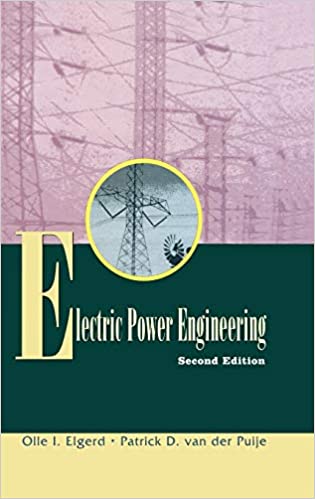 This book is about electric energy: its generation, its transmission from the point of generation to where it is required, and its transformation into required forms. To achieve this end, a number of devices are essential-such as generators, trans mission lines, transformers, and electric motors. We discuss the design, construc tion, and operating characteristics of the electric devices used in the transformation to and from electric energy. This text is designed to be used in a one-semester course in electric energy con version at the second-year level of the Bachelor of Engineering course. It is assumed that the student is familiar with the laws of thermodynamics and has taken a course in basic circuit analysis, including the application of phasors. We begin with a discussion of how humankind has successfully harnessed the energy of wind, water, the sun, biomass, animals, geothermal sources, fossils, and nuclear fission to make its life comfortable. Some of the consequences of this activity on the environment are examined. In Chapter 2, we review the basic physics of energy and its conversion. This may be, to some extent, a repetition of knowledge gained in high-school and first year university courses. However, we believe that such review is necessary to establish a suitable base from which to launch the subject of electric energy con version. 

|